Today, October 14, is World Day Against Waste Incineration: an opportunity to remember that the best waste is the waste that isn’t produced in the first place, and that the waste that is produced should first and foremost be recovered as a resource. It falls on the same day as International E-Waste Day, dedicated to electronic waste: two different observances that lead to the same conclusion.
What Does the Waste Hierarchy Say?
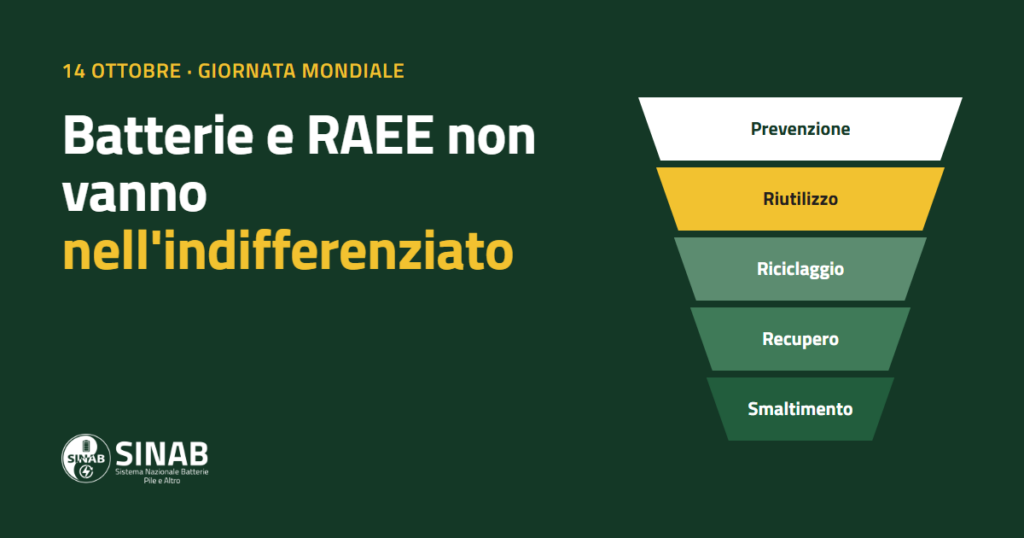
The legislation establishes a specific order. Article 179 of Legislative Decree 152/2006, in accordance with Directive 2008/98/EC, prioritizes prevention first, followed by preparation for reuse, recycling, other forms of recovery—such as energy recovery—and, lastly, disposal.
Where Does Italy Stand?
According to ISPRA’s 2025 Urban Waste Report, Italy generated just under 29.9 million metric tons of urban waste in 2024. Of this total:
- Separate waste collection has reached 67.7%;
- 54% was sent to material recovery facilities;
- 18% was incinerated;
- 15% was disposed of in a landfill.
The upcoming European targets are clear: to recycle 55% of municipal waste by 2025, 60% by 2030, and 65% by 2035, and to limit landfill disposal to a maximum of 10% by 2035.
Batteries and WEEE: Disposing of Them in the Wrong Place Costs Twice as Much
When a battery or a small electronic device ends up in the general waste bin, it is not recycled: it follows the same path as the rest of the general waste, through treatment, incineration, and landfilling. The cost is twofold:
- Materials such as lithium, nickel, cobalt, and copper are lost, but through recycling, they are turned back into raw materials;
- Lithium batteries can catch fire if they are crushed in collection vehicles or at processing facilities.
For this reason, they should be disposed of separately: used batteries should be placed in the designated containers found in many stores and supermarkets, while small WEEE items should be taken to your municipality’s collection center or to electronics stores that accept them.
What This Means for Businesses
Informing battery users is not just a best practice. Article 74 of Regulation (EU) 2023/1542 requires battery manufacturers, or organizations that fulfill producer responsibility on their behalf, to make information available to end users and distributors regarding the prevention and management of battery waste, including the impact of improper disposal methods, such as releasing batteries into the environment or disposing of them as unsorted municipal waste.
SINAB supports manufacturers and importers of batteries and electrical and electronic equipment in meeting their collection, recycling, and information obligations. To find out what your company needs, contact us at sinab.eu.