Lithium iron phosphate (LFP) batteries are playing a leading role in Europe’s energy transition. Increasingly common in electric vehicles and energy storage systems, these batteries are gaining market share thanks to three key advantages: lower costs, greater safety, and a long service life.
But behind this growth lies a challenge that the industry cannot afford to ignore: recycling.
Why are LFP batteries growing so rapidly?
In recent years, LFP batteries have become increasingly widespread compared to traditional lithium-ion batteries rich in nickel and cobalt.
The reasons are clear:
- they are cheaper to produce;
- ensure high safety standards;
- offer greater thermal stability;
- They have a very long service life.
These features make them particularly suitable for electric vehicles, stationary storage, and industrial applications.
The real issue: the end of life for LFP batteries?
While LFP batteries are a highly competitive solution from a technological standpoint, their end-of-life poses a significant challenge.
Unlike traditional nickel-cobalt batteries, LFP batteries contain materials with a much lower economic recovery value. This means that recycling processes are often less economically viable from an industrial standpoint.
In practice, the risk is that the cost of recovering the materials will exceed the economic value of the recovered materials.
And this is precisely where one of the most important battles for the future of batteries in Europe is being fought.
The European ReLiFe Project
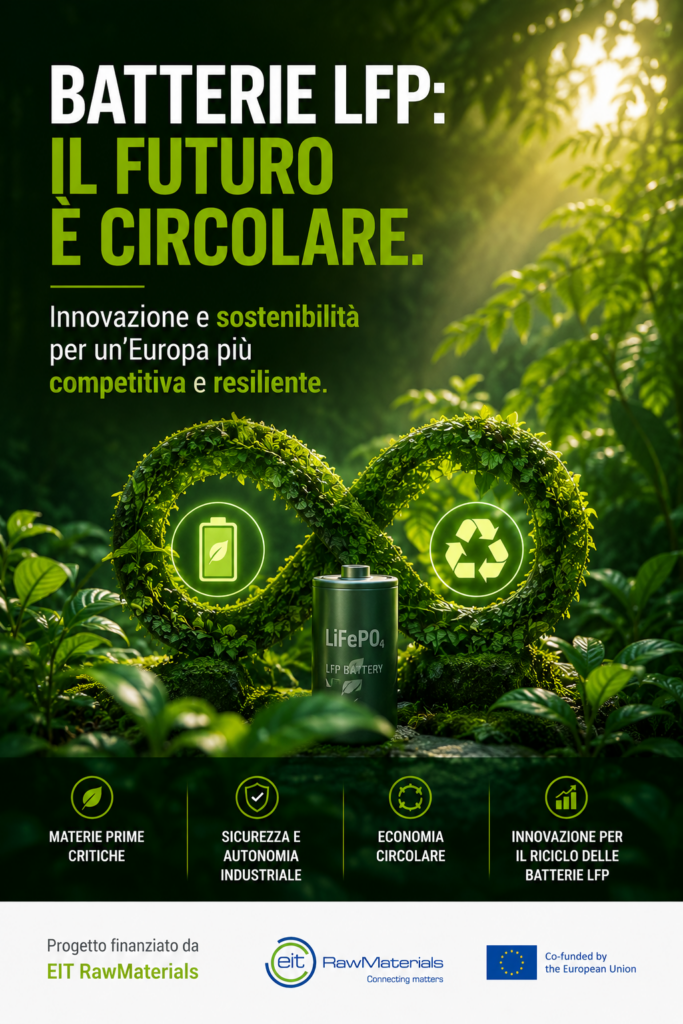
To address this challenge, ReLiFe—a project funded by EIT RawMaterials—has been launched with the aim of developing innovative processes for recycling LFP batteries.
The goal of the project is clear: to make material recovery economically sustainable by building a more resilient and competitive European supply chain.
Research and development activities focus on:
- improved material recovery efficiency;
- reduction in the industrial costs of recycling;
- development of sustainable and scalable processes;
- strengthening Europe's self-sufficiency in critical raw materials.
An issue that goes beyond the environment
The issue of recycling LFP batteries is not just about environmental sustainability.
In fact, we're talking about:
- security of European energy supply;
- supply chain resilience;
- strategic industrial autonomy;
- circular economy;
- the EU's industrial competitiveness.
In other words, Europe’s energy future will depend increasingly on the ability to recover and recycle the raw materials contained in end-of-life products.
Why is this issue of direct concern to businesses?
Companies involved in the production, import, or management of batteries are currently undergoing rapid industrial and regulatory change.
Understanding in advance how the recycling industry and European regulations are evolving means being able to:
- reduce risks;
- anticipate market changes;
- improve competitive positioning;
- prepare for future regulatory and sustainability requirements.
The Role of SINAB
At SINAB, we constantly monitor regulatory and industry trends in the battery sector, helping companies interpret European developments related to the circular economy, critical raw materials, and industrial sustainability.
If you’d like to learn more about this topic or receive additional information, please contact us directly!