From everyday objects to companions and caregivers. How is our relationship with technology changing?
Since its release in 1996, the Tamagotchi has revolutionized our relationship with electrical and electronic devices: no longer merely tools designed to perform a task or satisfy a practical need, but also objects capable of fulfilling an emotional and relational function.
Since 1996, we've taken care of over 100 million little virtual pets. We've fed them, cleaned up after them, and, most of all, grown attached to them.
The Tamagotchi represents the first major popular precedent for caring for an electronic device and ushered in a trend that is increasingly widespread today.
SMART SPEAKER
Smart speakers, which first entered our homes in the mid-2010s, began as home voice assistants but soon led us to develop the unusual habit of addressing a piece of equipment as if it were a conversation partner.
We say good morning to them, thank them, joke with them, and sometimes even get angry when they don’t understand what we’re asking. Above all, though, we call them by name, thereby validating their artificial “human” component.
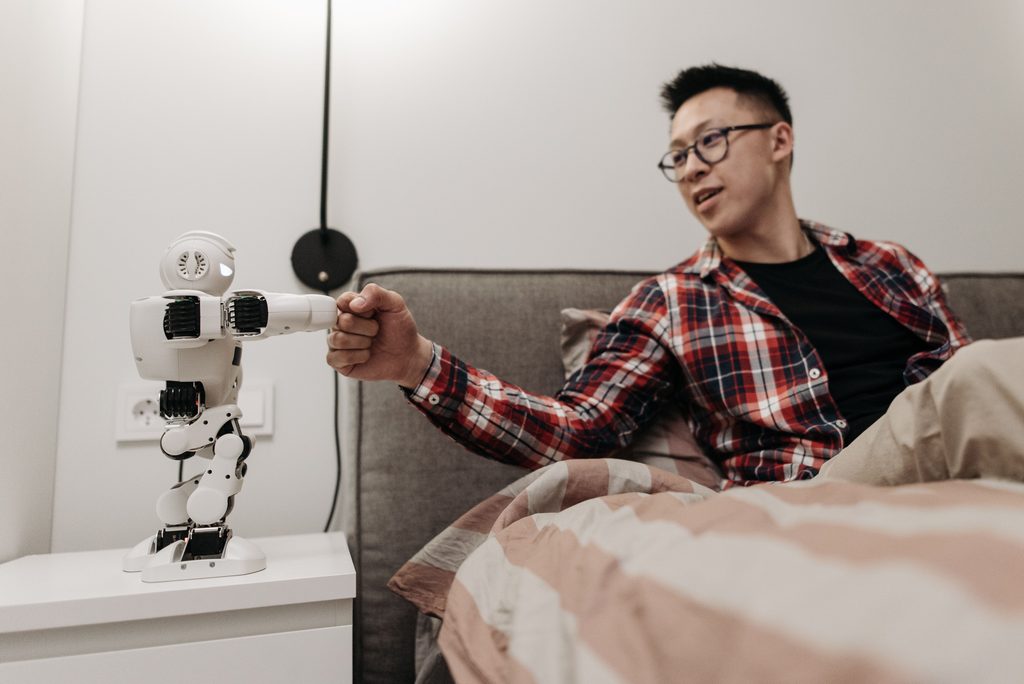
The relationship between people and devices is thus beginning to go beyond mere use: we talk to them.
AI TOYS
If your childhood was filled with long conversations with your favorite stuffed animal, you were probably the one doing all the work: you made up what it would say and even the voice it would use to say it.
Many children today, however, will not have the same memory.
In recent years, so-called “conversational toys” have become widespread: dolls, stuffed animals, and other devices capable of listening to what is said and formulating a response, engaging in actual conversations with the child.
ROBOT DOGS
In February 2026, the Washington Post reported on the growing popularity of electronic pets in China, particularly among young adults in urban areas.
Some of these robot dogs react to touch, recognize interactions, and develop personalized behaviors, gradually building a sense of familiarity with their owners.
The “advantage”? Immediate companionship, but with much lower costs and far fewer care responsibilities than those required by a real animal.
COMPANION DOLLS FOR SENIORS
In South Korea, AI-powered dolls designed specifically to keep older people company have been released on the market.
The doll waves, talks, sings, reminds them to take their medicine and eat their meals regularly, helps them maintain a routine, and uses affectionate expressions.
In some cases, the bond formed with these devices can become particularly strong, to the point where the doll is perceived as a genuine member of the household.
A VIRTUAL ROOMMATE
In 2026, companion holograms designed to share daily life with their users arrived in Japan.
The virtual character converses with the user, recognizes who is in front of it, greets the user when they return home, and accompanies them throughout the day.
A sort of virtual roommate, with its own voice and personality.
CAREGIVER ROBOT
In the United States, researchers at the University of New Hampshire are testing a home robot designed to assist people with Alzheimer's and other forms of dementia.
The robot moves around the home on its own and, thanks in part to a network of home sensors, can remind the person to eat, drink, take medication, exercise, and perform regular personal care activities, helping to ease the burden on family caregivers.
SOCIETY AND THE ENVIRONMENT
The growing presence of AEs in our emotional lives raises a number of questions that go far beyond technology.
In a society where loneliness and isolation affect ever-larger segments of the population, are we still capable of fostering social relationships without relying on technology to remedy our loneliness?
And what happens when these EEEs reach the end of their useful life?
No matter how sophisticated, endearing, or integrated into our daily lives they may be, they are still electrical and electronic devices.
Inside them are batteries, circuits, sensors, displays, and other components that, when the equipment reaches the end of its useful life, can be collected and sent for proper treatment, thereby recovering materials and resources.
And this is where the story comes full circle.
Ever since the Tamagotchi, we've learned to grow attached to digital pets.
Today, some of them even take care of us.
When they reach the end of their lives, it's up to us to take care of them.
Value? It starts at the end. Recycle!