
As of August 15, 2018, the "Open Scope" replaced the old closed list of ten WEEE categories in Directive 2012/19/EU. All EEE must now fall into one of the six categories in Annex III, regardless of sector or intended use. In practice, if a device is dependent on electricity (or electromagnetic fields) it enters the scope of the standard, except for a few specific exclusions.
In Italy, Open Scope is implemented in Legislative Decree 49/2014, complemented by the "Operational Directions" of the Supervisory and Control Committee that explain how to correctly classify products.
The six WEEE categories after 2018
| EEE Category. | Description |
|---|---|
| Large equipment | At least one side > 50 cm |
| Small equipment | No side > 50 cm |
| Small IT and telecom equipment | No side > 50 cm, computer/telephone use |
| Temperature exchange equipment | Refrigerators, air conditioners, heat pumps |
| Screens, monitors, panels | Surface area > 100 cm² |
| Light sources | Lamps, LED, neon |
The list is "open": if a product does not fit into the first three categories, simply measure its size to determine whether it is large or small.
What changes for manufacturers and importers
- Registration with the National EEE Registry (Chamber of Commerce).
- Marking: crossed-out dumpster symbol + identifier.
- End-of-life financing through collective or individual systems.
- Annual reporting of EEE placed on the market and WEEE withdrawn.
- User information on separate collection and proper disposal.
These obligations apply to anyone who introduces EEE to the Italian market, including importers of small batches that previously remained excluded.
Concrete impacts: collection numbers
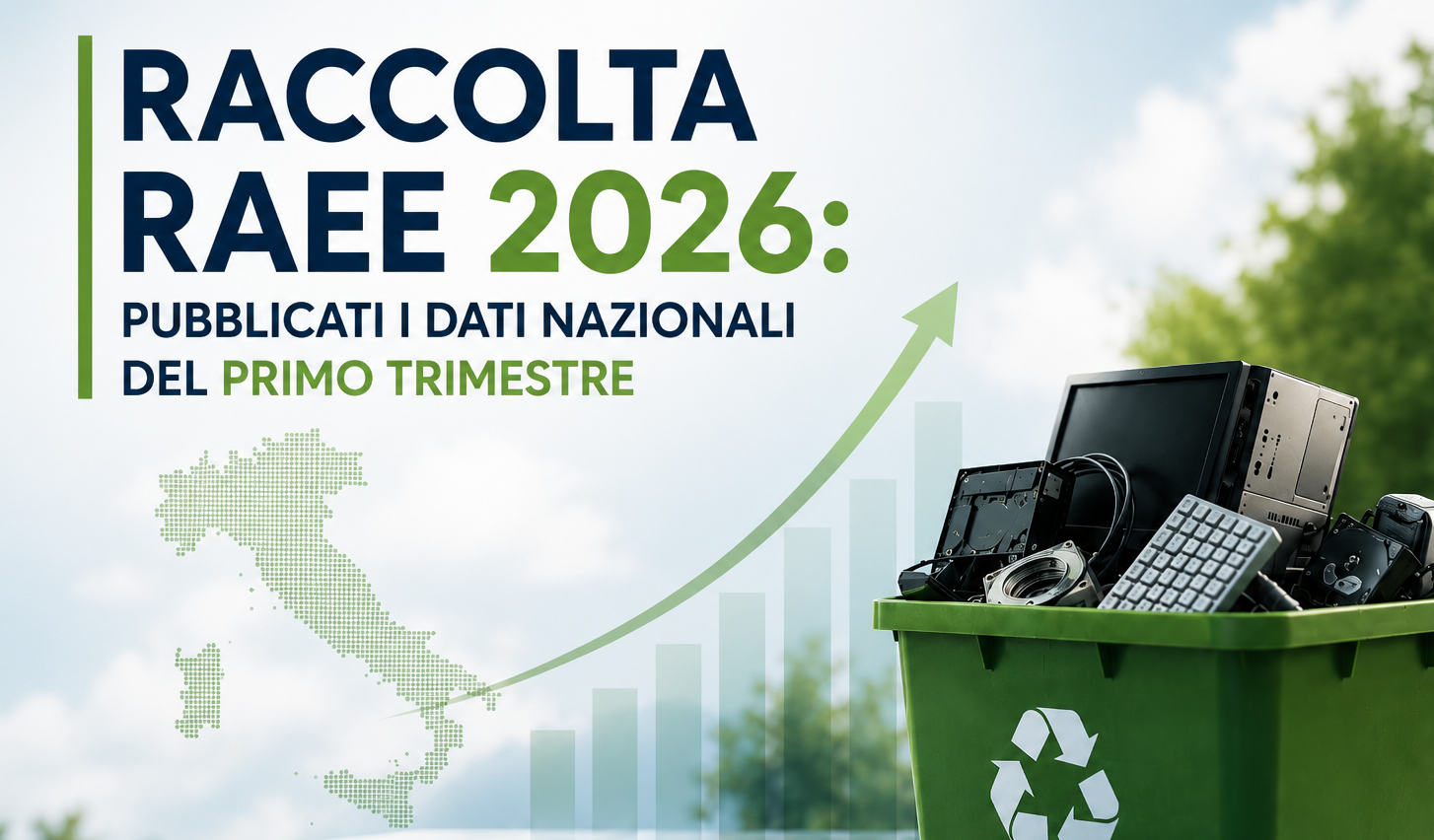
- 2023 - In Italy ≈ 349 000 t of WEEE was collected, equivalent to 5.92 kg/inhab (-3.1 % over 2022). The North remains the leader with 6.63 kg/inhab, but the South drops to 4.72 kg/inhab.
- 2024 - Upward trend: more than 92,000 t (+6.5% vs. 2023) were sent for recycling in the fourth quarter alone, driven by the R1 (refrigeration and climate) and R4 (small household appliances) groupings. More info here >
Scope extension has brought more waste under control, but national collection remains below the EU target of 65 percent of market input.
5. Why Open Scope is good news.
- Circular Economy - More equipment intercepted = more materials (precious metals, plastics) recovered.
- Competitiveness - Companies that design products that can be easily disassembled reduce end-of-life costs and improve their green image.
- Legality and fair competition - Eliminates "gray areas" where some operators were evading obligations.
6. How to adjust (quick checklist)
- Map your EEE catalog → assign the correct Open Scope category.
- Check exclusions (military, large fixed installations, etc.).
- Join/update the EEE Registry and choose a WEEE Consortium.
- Design for disassemblability and reduce hazardous substances (RoHS).
- Train the sales network on one-on-one pickup and free delivery.
- Notify customers of their obligation not to throw EEE in mixed waste.
The Open Scope has expanded responsibilities and opportunities. Complying is not just an obligation: it pays off environmentally, competitively, and brand-wise. If you produce or import EEE, take advantage of the legislation to rethink design and offer product turnaround services. That way you turn a cost into value and truly contribute to the circular transition.
Need support in classifying your products or setting up the collection system? Contact us, we will go over your case together.