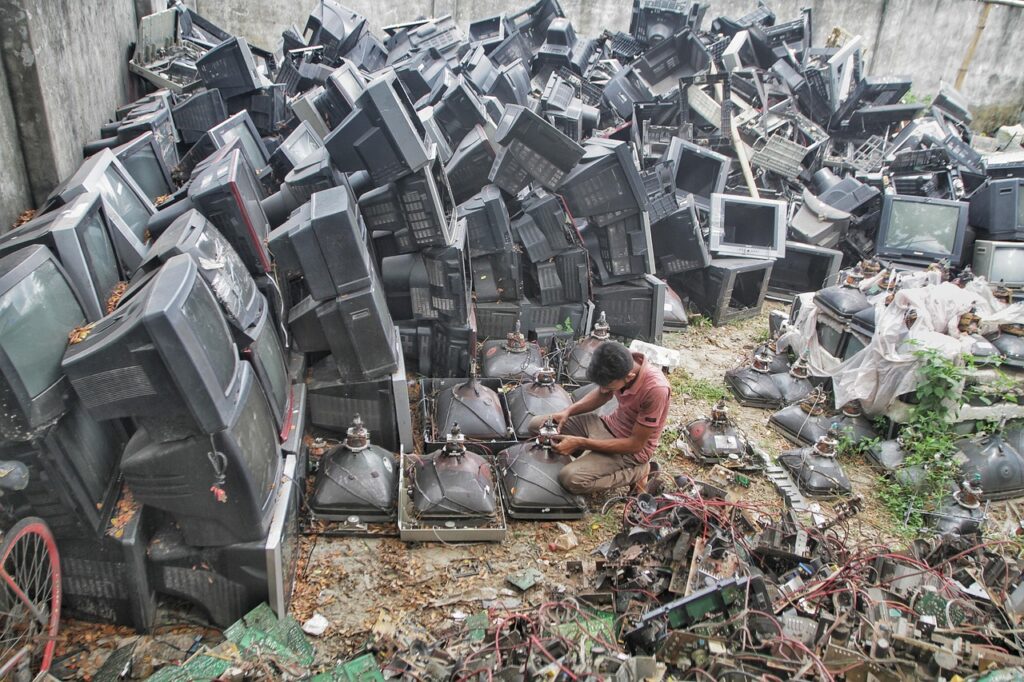
The 2024 edition of the Global E-Waste Monitor (GEM 2024), produced by UNITAR in collaboration with ITU, presents alarming data: global e-waste production is growing at a rate five times faster than documented collection and recycling.
This phenomenon calls for in-depth reflection on circular economy models, waste management policies, and corporate strategies for the ICT sector and beyond.
Key data
- In 2022, 62 million tons of e-waste were generated globally, an increase of 82% compared to 2010.
- Formally documented collection and recycling account for 22.3% of the total mass generated in 2022.
- The annual rate of increase in production is approximately 2.6 million tons per year, with a projection of approximately 82 million tons by 2030 (+32% compared to 2022).
- Only 1% of the demand for rare earth elements is met by recycling e-waste.
- The estimated value of metals embedded in e-waste in 2022 is approximately US$91 billion, including US$19 billion in copper, US$15 billion in gold, and US$16 billion in iron.
- Regional differences are marked: in Europe, approximately 17.6 kg per capita are generated annually, with documented collection/recycling of approximately 7.5 kg per capita; in Africa, however, documented collection is less than 1%.
Analysis and technical implications
1. Mismatch between generation and recycling
The report highlights that the growth in electronic waste production exceeds documented recycling by about five times. In practice, if production continues to grow by, for example, 6% per year, documented collection/recycling grows by only ~1.2%.
This misalignment creates a growing accumulation of waste that is not formally managed, with increasing environmental and health impacts.
2. Lost economic value
Waste contains enormous potential: precious metals, rare materials, plastic. The fact that most of these materials remain "unrecovered" means a direct economic loss and increased dependence on virgin minerals.
3. Environmental and health risks
E-waste contains hazardous substances (e.g., mercury, lead, hexavalent chromium) which, if not managed properly, can cause damage to health (nervous system, brain development) and the environment.
Furthermore, the illegal shipment of electronic waste to countries with weak infrastructure amplifies the risk.
4. Policies, infrastructure, and business models
- The report indicates that 81 countries had e-waste legislation in 2023 (up from 78 in 2019).
- However, only 46 countries have collection targets and only 36 have recycling targets.
- In terms of business models, there is a clear need to enhance repair, reuse, eco-design, and collection and treatment infrastructure.
What this means for companies and professionals
- For ICT/electronics companies: increase product lifespan, offer refurbishment and take-back services, design with recyclable materials and take-back strategies.
- For environmental and sustainability managers: monitor e-waste flows, consider extended producer responsibility (EPR), map supply chains for rare materials.
- For institutions and decision-makers: set more ambitious national targets, incentivize collection and recycling, prevent illegal exports, promote adequate infrastructure.
The GEM 2024 report is an urgent wake-up call: digital transition and e-mobility bring opportunities, but they also generate an avalanche of electronic waste that is growing faster than management solutions. To prevent this "wave" from overwhelming environments, economies, and communities, systemic approaches are needed—public-private partnerships, innovation in the circular economy, effective regulations, and sustainable business models.
It is an area in which every player has a role: producer, user, institution, recycler.
Let's do our part for a sustainable future! 💡🌍